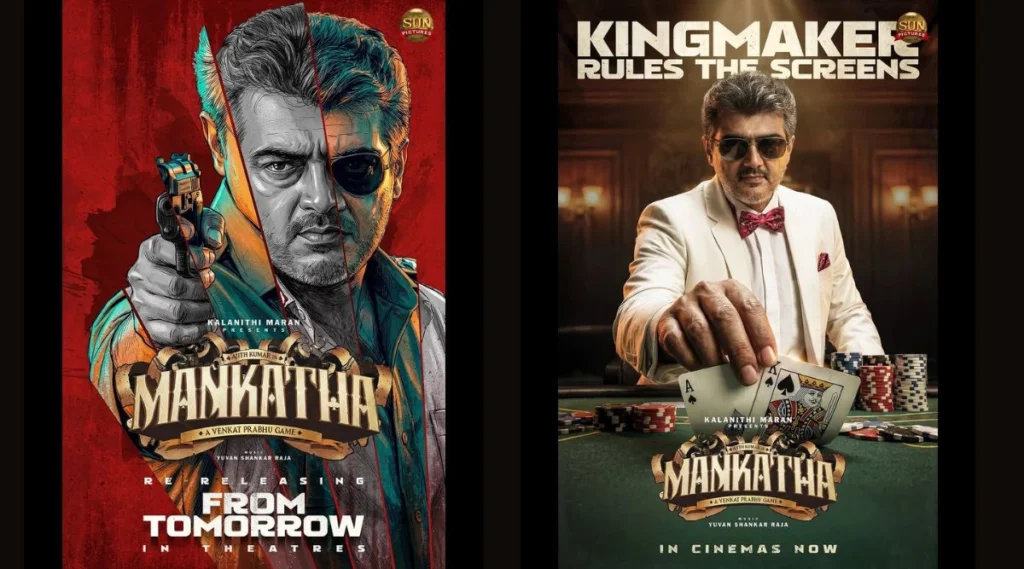

Mankatha had a massive response with its re-release in 2026, just like it did back in 2011 when it was released for the first time.
First-day ticket bookings were full. Bookings opened two to three days before the re-release, and for those two to three days, all tickets were sold out. On weekends, it was totally wiped out from every theater where it was re-released.
On social media, it was a wave of nostalgia fans relived that 2011 magic. But this time, 90s kids who couldn’t go to theaters back then flocked to the cinema, eager to celebrate and see Ajith Kumar on the big screen.
But why are re-released movies getting more response than new ones, which often have empty theaters just days after release? Let’s explore this fresh and curious trend!
Mankatha: The Game-Changer That Redefined Ajith’s Stardom
Mankatha, released in 2011, was a massive hit, collecting around ₹130 crore, a colossal feat at the time. It was Ajith Kumar’s first film to enter the 100-crore club.
Mankatha wasn’t just a box office milestone; it was a defining moment of mass appeal. Just as Vijay had Thuppakki, Mankatha became the ultimate crowd-pleaser for Ajith. It’s remembered as one of his best, even after all these years.
The Re-Release Wave: What’s Really Happening in Tamil Cinema
Many films are released every week, but the majority vanish from theaters within just two or three days. Audiences don’t show up, and the screens end up running empty.
Beyond Mankatha, re-releases like 3, Ghilli, and Padayappa have drawn massive crowds, bringing people back to theaters and turning screenings into full-blown celebrations.
This isn’t just a one-off thing, it’s a pattern. Why aren’t people going to new movies? Why are they excited about these re-releases? Is it just nostalgia, or are new films lacking something, like fresh stories? In this blog, we’re going to talk about exactly that.
Fans turned the Mankatha re-release into a full celebration - whistles, chants, and packed houses everywhere, showing how much this film still means to audiences after all these years.
Top Tamil Re-Releases That Captured Hearts
Ghilli
The 2024 4K re-release of Ghilli earned between ₹26 to ₹32.5 crore, highlighting its lasting appeal.
Padayappa
Padayappa’s re-release brought in around ₹20.5 crore, rekindling the superstar magic and drawing large audiences.
Mankatha
In 2026, Mankatha’s re-release achieved about ₹10.25 crore, creating a festive atmosphere and drawing enthusiastic fans.
What People Are Actually Waiting For
If people really stopped caring about theatres, films like Meiyazhagan and Lubber Pandhu wouldn’t have worked. But they did. And they worked for a very simple reason. They felt fresh. They felt honest.
Especially Lubber Pandhu. It didn’t become a hit because of heavy marketing or reel trends. It worked mainly because of word of mouth. People watched it, liked it, and told others to watch it. That’s it. No big noise. No forced hype. Just people connecting with the film and spreading the word.
This clearly shows one thing. Audiences are not against new movies. They are ready to come to theatres if the film feels different and genuine. When that gap exists, re-releases naturally step in.
Not just because they are old and nostalgic, but because they are well made. The story is clear. The characters make sense. The music works. You watch the film and feel satisfied. You don’t come out asking, “Why did I even watch this?”
As Tamil cinema fans, we’re not asking for miracles. We know this industry can do better. We’ve seen it happen.
Conclusion: The Future of Re-Releases and New Tamil Movies
This doesn’t feel like the end of Tamil movie re-releases. If anything, it feels like the beginning of something bigger. More classics will return to theatres, and many of them will likely perform even better than before. These re-releases are bringing audiences back, reminding people why going to the theatre still matters.
At the same time, there is real hope for new Tamil movies too. When fresh, well-made films come along, audiences are ready to support them. The goal is not to choose between old films and new ones. The real win is being able to celebrate both. Watching movies in theatres with friends and family, enjoying that shared experience, and feeling that social connection again. That’s what Tamil cinema has always done best, and that’s what audiences are waiting for.